ClimateTrade News

ClimateTrade News

ClimateTrade E-Verde
ClimateTrade News

ClimateTrade expands its offering with E-Verde’s innovative carbon calculators

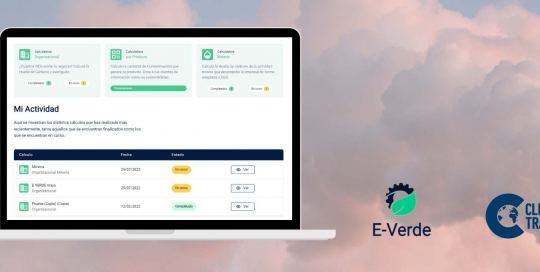
ClimateTrade announces the acquisition of E-Verde to expand its carbon calculation capabilities. ClimateTrade, the first blockchain-based climate marketplace, announces today the acquisition of E-Verde, an SaaS provider specialized in carbon footprint calculation, with the purpose of expanding its calculation capacities and meet the needs of its clients. The Valencian tech company already offers several automated carbon footprint calculators for the mobility, building and airline sectors, which are being used by clients such as Cabify or Melia Hotels. Now with E-Verde’s software, it is adding other calculators for specific sectors looking to expand their ESG and sustainability initiatives. Moreover, E-Verde’s founder, Nerea García, joins ClimateTrade as calculation specialist within the company’s consulting team, bringing her experience and knowledge to support the development of more sector-specific calculators. Francisco Benedito, ClimateTrade CEO, comments: “Calculating carbon footprint is a key moment in our clients’ decarbonization journey, and E-Verde’s calculators, now integrated within our services, allow them to conduct this activity autonomously and accurately.” With these initiatives, ClimateTrade is enriching its portfolio of services and supporting the decarbonization of companies that want to take action against climate change through a 360 offering and experience: on top of its calculation services, the company offers a blockchain-based platform facilitating transparent carbon offsetting. Its climate marketplace connects carbon mitigation project developers directly with companies looking to offset their footprint, while its API allows companies to offer carbon-neutral products and services to their clients. For E-Verde, the acquisition represents a growth opportunity and access to new markets. The company, which was born from its founder’s final project at university, was one of the winners of the 9th Startup Creation Marathon organized by Miguel Hernandez University in 2020, and shortly after was added to its startup hub. “E-Verde was born as a response to companies’ need to calculate their emissions in the easiest way in order to develop their industrial activities in a more sustainable way. Now, ClimateTrade offers E-Verde the development and growth opportunity the project needed to meet its objective,” notes García.

ClimateTrade U.S.
ClimateTrade News

ClimateTrade Announces New U.S. Headquarters in Miami, Hiring of U.S. Business and Policy Advisor

Climate solutions provider ClimateTrade looks to grow network of partners, project developers in the U.S. MIAMI, July 13, 2022 — ClimateTrade, the world’s first blockchain-based climate solutions provider, announced today that it is expanding its footprint in the U.S. with a new headquarters in Miami. The company also announced that it has hired a U.S. business and policy advisor with plans to further expand its U.S.-based team in the near future. These moves will enable ClimateTrade to scale up its operation in the U.S. and strengthen its relationships with American businesses, project developers and policymakers. “We couldn’t be more excited to open our first U.S. headquarters in Miami, a hub for innovation and a leader in sustainability,” said Francisco Benedito, co-founder and CEO of ClimateTrade. “Having a physical presence here will enable us to grow our network of partners and project developers and help more companies reduce their carbon emissions and achieve their broader ESG goals.” As part of ClimateTrade’s U.S. expansion, the company has announced the hiring of Michael Green as U.S. business and policy advisor. The former executive director at Climate XChange, with experience at the UN, American Sustainable Business Network and the Climate Action Business Association, Green brings extensive international climate science policy expertise as well as business acumen to ClimateTrade. He will assist the company’s push to engage with American businesses and project developers as well as lead efforts to develop a favorable climate policy environment in the U.S. “Engaging businesses with meaningful opportunities to address the climate crisis is something we must do,” said Green. “And I believe ClimateTrade has the technology, the people, and the vision to do it.” ClimateTrade has experienced a 65 percent growth in employees over the past year and is in the process of further expanding its U.S.-based team with the hiring of a chief commercial officer and chief financial officer. The company also recently joined more than 1,000 U.S.-based businesses to implore Congress and President Biden to take bold action on climate change. About ClimateTrade ClimateTrade is a blockchain-based climate pioneer, aiming to empower large-scale decarbonization through constant innovation. The ClimateTrade marketplace allows companies to offset their climate impact by purchasing carbon, plastic and biodiversity offsets, as well as renewable energy certificates directly from project developers.

ClimateTrade Whitelabel
ClimateTrade News

ClimateTrade Whitelabel: the easiest way to offer carbon-neutral products and services

After the success of its API and Widget, ClimateTrade launches a Whitelabel solution, allowing organizations to give their clients the possibility to offset their carbon footprint with no need for integration or a payment platform. The ClimateTrade Whitelabel consists of a landing page built by ClimateTrade according to our client’s brand specifications, where end customers can visualize the carbon footprint associated with an activity or purchase, and offset it by contributing to one of the carbon mitigation projects from the ClimateTrade marketplace.  Compared to the ClimateTrade API and Widget, the Whitelabel offsetting is not integrated into the checkout process. Instead, the customer is prompted to offset their carbon footprint via email or other channels that lead them to the aforementioned landing page. ClimateTrade handles the full checkout process and automatically sends an offsetting certificate to the client when a transaction is concluded. In essence, the ClimateTrade Whitelabel is a hassle-free option for organizations that want to give their customers or members the option to offset their carbon footprint independently, without having to handle payments.  This is the latest addition to our suite of carbon offsetting software to support clients in offsetting their Scope 3 emissions. The ClimateTrade API and Widget can be integrated into clients’ webpage or point of sale to give their customers the option to offset the carbon footprint of their purchases directly at checkout.  The API has already been integrated into the platforms of clients like Iberia or Melia Hotels, and is perfectly suited for large organizations that want a customized experience, while the Widget is easier to integrate and more practical for SMEs.  Because of its ease of use, the Whitelabel is perfect for organizations of any size that want a quick solution to urge their customers towards offsetting their carbon footprint. It only takes a couple of hours to set up, and doesn’t require any special IT skills or payment infrastructure. Get in touch with our experts today to schedule a demo, or complete your registration on our marketplace to find out more about our work.

ClimateTrade IETA
Carbon Markets

ClimateTrade is now a member of IETA

ClimateTrade has become a member of the International Emissions Trading Association (IETA), the leading non-profit business association working to establish a functioning carbon market. Joining IETA will allow ClimateTrade to be part of international efforts to create effective market-based trading systems for carbon emissions and advance the United Nations’ Sustainable Development Goals. IETA members include financial institutions, carbon brokers and traders, consultants, energy and power providers, industry, law firms, standards and registries, as well as technology providers such as ClimateTrade. The association has set up a number of working groups to analyse the market and suggest new policies and protocols around forestry, REDD+, voluntary markets, market oversight, and how decisions in the US and EU are affecting players and investors, directly and indirectly. “Joining IETA gives ClimateTrade a seat at the table with the world’s major business leaders to discuss and influence the future of carbon markets. We look forward to working with the association and its members to shape the way forward and support large-scale global decarbonization,” says Francisco Benedito, CEO of ClimateTrade.

TravelX ClimateTrade
Blockchain Technology

ClimateTrade and TravelX Partner to Decarbonize Travel with NFTickets

The partnership will enable travelers to offset their carbon emissions with one click. Miami, FL – June 7, 2022 – ClimateTrade, the world’s first blockchain-based climate solutions provider, today announced a partnership agreement with TravelX, the company building the travel industry’s blockchain-based distribution and retailing infrastructure. The partnership will help decarbonize the travel industry through the integration of ClimateTrade’s API and TravelX’s NFTickets, tokenized flight tickets traded and recorded securely on the blockchain. “We are extremely excited to be a part of TravelX’s mission to evolve the travel industry, making it more sustainable, efficient, and cost-effective. This partnership signifies a giant step in the right direction towards decarbonization in the travel industry,” said Francisco Benedito, ClimateTrade CEO. Through the integration of ClimateTrade’s API, customers buying NFTickets via TravelX’s platform can easily calculate and choose to offset the emissions of their corresponding flights. Those customers will contribute to mitigation projects, such as reforestation and renewable energy, as selected by TravelX from the more than 60 verified global projects currently available on ClimateTrade’s marketplace. Upon concluding a transaction, customers will automatically receive a personalized certificate with information about the amount of CO2 they offset, as well as a blockchain key for traceability, guaranteeing a direct impact in different Sustainable Developments Goal determined by the UN.  “We really believe that a better, more sustainable travel industry is possible. We are creating the blockchain-based infrastructure and the right ecosystem to make that happen. We are happy to partner with ClimateTrade to help offset the carbon footprint of the travel industry together,” said Facundo Diaz, Co-founder TravelX. The companies will celebrate the alliance by hosting a networking event on Wednesday, June 8 at Mila in Miami after the closing of World Aviation Festival Americas.  About TravelX Led by a team of tech and travel industry veterans with a track record of pioneering change, TravelX is building a blockchain-based distribution protocol developed to create a more secure, decentralized, frictionless, transparent, and efficient travel industry. Learn more at www.travelx.io.   About ClimateTrade ClimateTrade is a blockchain-based climate pioneer, aiming to empower large-scale decarbonization through constant innovation. The ClimateTrade marketplace allows companies to offset their climate impact by purchasing carbon, plastic and biodiversity offsets, as well as renewable energy certificates directly from project developers. Learn more at www.climatetrade.com.

EU ETS reform
Carbon Markets

EU ETS Reform: What’s to come for the mandatory carbon market

In a Decarb Connect Webinar held online on May 25th, ClimateTrade CEO Francisco Benedito and NWorld Partner Gregorio Gonzalo discussed upcoming changes in the EU ETS, and how companies can prepare for them. The webinar, which you can watch here, couldn’t have been more timely: on May 17th, the EU Parliament voted in favor of a comprehensive reform of the EU ETS, in line with the Fit for 55 package. Among the changes included in the reform, Gonzalo pointed to seven key aspects: Accelerating emissions reduction: cutting emissions by 60% by 2030 compared to 2005 baseline New sectors covered by the EU ETS: maritime, road transportation and buildings Increased coverage around aviation: all flights operated by EU-based aircraft Carbon capture and storage: emissions captured could be deducted Reinforcement of market stability: upper limit for number of allowances permitted to be in circulation, but also lower limit to ensure there are enough allowances in the market, ensuring supply and demand balance All revenues from EU ETS should be destined to climate-related purposes, a boon for low-carbon technologies Gradual phase-out of free allowances by 2030 More on this topic: EU ETS: What it is and why it is changing ClimateTrade enters mandatory carbon market EU ETS price and demand impact of the reform Speaking about the expected impact of this reform on EUA demand and prices, Benedito laid out some of the key pricing drivers: as global production and CO2 emissions decreased during the pandemic, there was a significant surplus of EUAs accumulated, which lowered the price of EUAs to about 36€ per unit. However, the war between Ukraine and Russia and the uncertainty around gas supply led to an increase in coal use for electricity production, which is highly polluting. As a result, the EUA surplus is fading away, and this reform will reduce EUA supply even more.  In February 2022, the price of EUAs reached a record 98€ per unit, before the new reform was even adopted. Companies that need to buy EUAs to comply with emissions regulations are facing a declining supply of allowances in the coming eight years as free allocations are set to be phased out. In fact, the number of EUAs issued into the market each year is set to decline at 2.2% a year from 2021 through 2030.  “Most analysts believe this will lead to a much smaller supply of EUAs. This month, EUAs are priced around 90€ and some analysts believe this price will reach 150€ in 2023,” he said.  One thing that’s becoming clear with this new reform is that eventually, all sectors of the economy will be forced to offset their emissions. The package even talks about including citizens in the EU ETS around the end of this decade. New sectors, new measures Gonzalo then dove into some of the new sectors to be included in the EU ETS and what specific measures will apply to them. When it comes to maritime transport, all emissions coming from intra-EU voyages will be included, as well as up to 50% of emissions from travel outside the EU. “There will be a transition period between 2023 and 2025 when maritime companies are going to have to gradually buy allowances up to 100% of their verified emissions, which should all be compensated between 2026 and 2027. Implications of not complying are quite severe,” he noted. Maritime companies now need to submit a monitoring plan for each of their ships and hand it to authorities in the next three months. Road transportation and buildings will have special treatment, as they will operate within a separate ETS system commonly referred to as ETS II, which should be functional from 2025. From 2025 to 2029, only commercial fleets and buildings will have to comply, but the scheme will be extended to private cars and buildings after 2029.  More on this topic: Advanced ESG criteria for new and retrofitted buildings ClimateTrade launches carbon footprint calculator for the construction sector EU ETS cost burden Gonzalo and Benedito agreed that there is very little public information around transaction costs for purchasing, selling or cancelling carbon credits in the EU ETS. But a June 2020 working paper published by the London School of Economics and quoted in ClimateTrade’s white paper on the EU ETS offers a quantitative approach to understanding EUA transaction costs. The paper found that costs of around €10,000 per year plus €1 per permit traded allowed the most accurate predictions. These transaction costs include exchange membership fees, the resources invested in operating a trading desk, monitoring the market and defining a trading strategy, as well as search, information, brokerage, intermediation and consultancy costs, and they are a barrier to entry from the EUA market. “The new reform, as well as the implementation of the Carbon Border Adjustment Mechanism (CBAM) will most likely increase this cost burden,” said Benedito. More on this topic: White paper: A 2030 Outlook for Europe’s Mandatory Carbon Market Carbon Border Adjustment Mechanism The Carbon Border Adjustment Mechanism (CBAM) is the EU’s solution to prevent carbon leakage, considered one of the key elements of the Fit for 55 package. “Let’s try not to favour EU industries moving to countries with less stringent requirements on carbon, and let’s try not to replace European products with more polluting but cheaper products from outside the EU,” explained Gonzalo.  CBAM also aims to incentivize non-EU countries to promote cleaner industries: while the price of the CBAM certificates to be purchased by EU importers will be based on the weekly average auction price of EU ETS allowances (EUAs), if goods are imported from a country with a carbon scheme, that price will be deducted from the cost of CBAM certificates. The EU has now begun a transitional phase to gather data until 2025, and CBAM is expected to be fully in place in 2026, initially applying to industries like cement, aluminium, steel, fertilizers and electricity, but later to be extended to all sectors within the EU ETS. EU importers will have

Other Categories

ClimateTrade FLACMA
ClimateTrade News

Blockchain and emerging technologies applied to the carbon-negative future of cities

ClimateTrade, Climatecoin and FLACMA announce the signing of a Memorandum of Collaboration on technology transfer, research and development activities that will contribute to the fulfilment of Latin American cities’ decarbonization plans. Through this agreement, ClimateTrade, Climatecoin and the Latin American Federation of Municipalities (FLACMA) will work together to develop local carbon footprint offsetting markets/mechanisms, with the aim of achieving climate and health benefits. Climate change affects the social and environmental determinants of health: clean air, clean water, safe food and shelter. Between 2030 and 2050, climate change is expected to cause approximately 250,000 additional deaths per year from malnutrition, malaria, diarrhoea and heat stress. Cities are key to a net-zero emissions future, with 50% of the population living in cities today and 70% by 2050. Digitalization is driving self-consumption energy transitions, increasing distributed renewables to reduce the use of fossil fuels.   “Partnerships like FLACMA are essential to bringing knowledge and climate awareness to different parts of the world; that is why, from ClimateTrade, we are proud of partnerships like this because we know that they have the potential to have a real impact on the environment,” said Francisco Benedito, CEO of ClimateTrade. “The cities and municipalities of Latin America have an enormous potential to contribute to the improvement of our planet through countless actions that will lead to a reduction in carbon emissions, but at the same time, they have enormous financing needs to undertake these actions,” added Leopoldo Arnaiz Eguren, Executive President of the Advisory Council of the Latin American Federation of Municipalities (FLACMA). “In the next quarter, we will implement several proofs of concept in different cities in Latin America, which will be based on the origination of carbon credits thanks to Distributed Ledger Technology (blockchain). The agreement is a significant opportunity to improve quality of life, sustainable growth, energy efficiency and increase productivity in large urban centres,” noted Javier Manzanares, Co-CEO of Climatecoin. The effect of climate policy uncertainty by national governments increases the urgency for immediate action at the local and metropolitan levels.  Carbon markets have the potential to reduce emissions from cities and municipalities as well as increase infrastructure financing, and need to be harnessed to accelerate urban emissions reductions.    About Climatecoin   Climatecoin is the creator of the world’s first digital carbon asset. With a carbon-neutral blockchain backed by high-quality carbon credits, Climatecoin will fund credible, high-impact decarbonisation projects around the world, providing investors and climate advocates with a meaningful investment to offset their carbon footprints. The company aims to unleash a global investment movement to neutralise and reverse the Earth’s climate threat by democratising climate finance.  More information at www.climatecoin.com   About FLACMA Flacma constitutes the most important international organisation in Latin America in the municipal world, bringing together different cities and national associations of municipalities from all countries. The Federation’s main objective is to strengthen municipalities and facilitate their decentralisation, supporting their economic development in order to achieve greater well-being for their citizens. The advisory council fosters partnerships and agreements for these purposes and pilots significant projects linked to the SDGs and climate change.  More information at www.cc-flacma.org   About ClimateTrade ClimateTrade is a pioneering blockchain-based climate solutions provider, aiming to facilitate large-scale decarbonisation through continuous innovation. On its marketplace, companies can buy carbon, plastic and biodiversity credits, renewable energy certificates or iRECs in a transparent and traceable way. ClimateTrade’s API, Widget and Whitelabel allow customers to integrate the marketplace functionalities into their own platform, making their products climate-positive. ClimateTrade also leads efforts for digital certification of mitigation projects, and supports the digitisation of carbon registries.  More information at: www.climatetrade.com

finovate
ClimateTrade News

ClimateTrade Demos at Finovate Fall 2023

Last month ClimateTrade’s CEO and Co-Founder Fran Benedito took the stage at the prestigious Finovate Fall 2023 event, showcasing our climate action platform to an audience of fintech industry leaders, innovators, and enthusiasts.