ClimateTrade News

ClimateTrade News

Monitoring Reporting Verification
Climate Impact

BME and ClimateTrade PoC paves the way for digital verification and certification of climate mitigation projects

BME and ClimateTrade PoC paves the way for the digital verification and certification of climate mitigation projects, facilitating large-scale carbon offsetting activities through blockchain. National carbon registry The proof of concept (PoC) announced on February 21 follows the creation of Spain’s first national carbon credit registry based on blockchain last year by Iberclear (BME). Its success lays the bases for digitizing the verification and certification process for projects that generate carbon credits, as well as their addition to the registry, making it all more efficient and transparent, and guaranteeing the quality of carbon credit supply in the national registry. The PoC was achieved through one of ACCIONA Energy’s photovoltaic plants: as project developer, ACCIONA communicated all the necessary information via a digital questionnaire based on blockchain, which guaranteed the immutability of the data. SGS Tecnos, S.A.U., as the independent verifying entity, verified the data and sent it to the certification entity, which was able to emit certification digitally. Digital MRV Digital Monitoring, Reporting and Verification (D-MRV) is an end-to-end solution that allows the optimization of this process and guarantees the authenticity and traceability of the carbon credits available on the Iberclear registry. Project developers will be able to register their mitigation in a public and traceable way, allowing all users to verify the integrity of data. This, in turn, will facilitate the transparent purchase of carbon credits and their automated cancellation on the ClimateTrade marketplace for carbon footprint offsetting. Transparency and data integrity This PoC will be key for the correct functioning of future voluntary carbon mechanisms. On top of managing the information and monitoring mitigation initiatives, it certifies the cancellation and transfer of carbon credits, guaranteeing full transparency and better integrity. This means that all players involved in carbon offsetting transactions will have the certainty that these transactions abide by the premises of the latest national and European laws for the fulfillment of the Paris Agreement. Through this initiative, BME strengthens its commitment to helping Spain lead the fight against climate change in an efficient and innovative way, to encourage energy efficiency and offsetting projects by companies and to complement existing public regulatory and offsetting mechanisms.   For more information, please contact us.

ClimateTrade Series A
ClimateTrade News

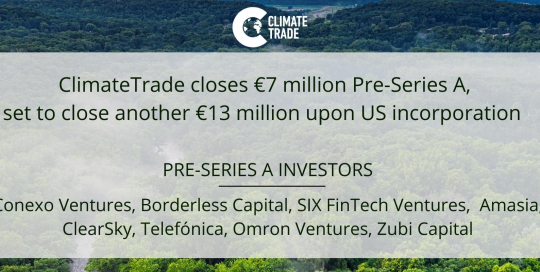
ClimateTrade closes €7 million Pre-Series A, targets another €13 million to expand world’s first climate marketplace in new markets

In total, ClimateTrade is targeting €20 million of funding for international expansion. Valencia – 24 January 2022: ClimateTrade, the leading blockchain-enabled climate marketplace, has raised €7 million in a Pre-Series A closed in Europe in late 2021, and is raising another €13 million in a US-focused round set to close upon ClimateTrade’s US reincorporation in the next five months. In total, the company is targeting €20 million of funding for international expansion. ClimateTrade is a Spanish-based marketplace helping companies achieve their decarbonization goals by financing certified carbon offsetting and climate-regenerative projects around the world. This new capital will help to grow the startup’s activities in Europe, Asia and the US with new offices in four countries, to expand its technological product offering and to hire new talent. The first round was oversubscribed, with interest from more than 90 investment funds. The €7 million was provided by Spanish investment firm GED via its VC fund Conexo Ventures, US power and technology fund ClearSky, blockchain investor Borderless Capital, SIX FinTech Ventures, the VC arm of Swiss financial infrastructure provider SIX Group, Spain’s Telefónica via its open innovation hub Wayra, the investment arm of Japanese corporation Omron Ventures, climate VC Amasia, and Valencian impact fund Zubi Capital, which is backed by the founder of payment unicorn Flywire, Iker Macaide. “For four years, ClimateTrade’s vision has been to enable climate action through technological innovation. Our blockchain-backed marketplace allowed companies to offset almost 2 million tons of CO2 in 2021 alone. This oversubscribed funding round is a testament to the impact ClimateTrade has already generated, and we are excited to further our action against climate change with this new infusion of capital,” commented Francisco Benedito, ClimateTrade’s CEO. The second phase of this Series A, expected to raise €13 million, will be closed in the US upon ClimateTrade’s reincorporation later this year, and has received interest from several global investors. ClimateTrade US will be headquartered in Miami, a strategic choice given the city’s interest in combating the climate crisis, and its emergence as a global hub for the decentralized economy. ClimateTrade’s clients include Cabify, Banco Santander, Telefónica, Correos and Telégrafos, Prosegur and many others. A pioneer in the development of its blockchain marketplace for climate, the company recently launched an API and Widget to allow companies to offer carbon-neutral products and services to their customers. For more information, please contact us.

UIA International Forum 2022
ClimateTrade News

UIA International Forum 2022 moves towards carbon neutrality

The agreement signed between ClimateTrade and the UIA International Forum 2022 will drive dozens of affordable housing events towards carbon neutrality, strengthening global efforts to achieve the Sustainable Development Goals (SDGs). Through this collaboration, the Affordable Housing Activation (AHA) event in Madrid on May 18-20 will be made carbon-neutral, and side event organizers will be incentivized to calculate and offset their carbon footprint. The UIA International Forum 2022, named ‘Affordable Housing Activation Removing Barriers’, promotes a collaborative and innovative framework to improve housing affordability in the world, which is part of SDG 11 (Sustainable Cities and Communities). Between January and May 2022, dozens of events will be organized in different regions and countries, and they will be supported by Spain’s architecture association CSCAE, the Forum’s organizer, to reach carbon neutrality through CO2 emissions offset. This means that the Forum is effectively targeting SDG 11 and SDG 13 (Climate Action) through the same project. The Forum will be concluded in the Spanish capital with AHA Madrid, the emissions of which will be calculated and offset through the financing of mitigation projects on ClimateTrade’s marketplace. Angela Baldellou, executive director of the AHA Forum, notes: “With this initiative, we are supporting international side event organizers on their path towards more sustainable events and actions, by enabling the offset of their carbon footprint. To achieve this, we can count on ClimateTrade’s collaboration to make the processes simpler and more digital, opening the doors to the world of environmental projects for participating companies and allowing them to contribute without intermediaries. It is fundamental to raise awareness, mitigate climate change and offer coherent responses to the multiple-crisis scenario we are facing: affordability responses cannot go against sustainability goals. Quite the opposite: when we create an activist movement, it needs to go in the same direction as the others and contribute to complete sustainability.” Moreover, these events will be presented in a hybrid online/in-person format, cutting their emissions by 50-60% compared to purely physical events. Francisco Martín, Head of Engineering and Key Account Manager at ClimateTrade, adds: “We are excited about this new collaboration with CSCAE, through which AHA’s main event and its side events can benefit from our company’s experience in international events and congresses in the US, Argentina and Spain, among others.” About CSCAE Created in 1931, Spain’s Architect Association (Consejo Superior de los Colegios de Arquitectos de España or CSCAE) is an entity gathering all architect associations in Spain for the promotion of architecture and the pursuit of common objectives. It represents these associations and the more than 47,000 professional architects working in Spain for public and private corporations, as well as for international organizations. The association recently launched a carbon footprint calculator for the construction sector. For more information www.cscae.com. About ClimateTrade   ClimateTrade is a Spanish-based climate marketplace helping  global brands  achieve their sustainability goals by offsetting CO2 emissions and financing climate regenerative projects. Pioneering the development of its blockchain marketplace, ClimateTrade recently launched an API and a Widget that allow companies to offer carbon-neutral products and services to their customers. 

PlanetWatch carbon offsetting
ClimateTrade News

PlanetWatch offers carbon offsetting to its community with ClimateTrade

30 November 2021, London – PlanetWatch, the world’s first decentralised indoor and outdoor air quality monitoring network, will now offer its user community the possibility to convert PLANET tokens into carbon credits issued by ClimateTrade to contribute to sustainable carbon emission reducing plans. Founded in  2020, PlanetWatch is a spinoff of the European Organization for Nuclear Research (CERN). The data collected by PlanetWatch air sensors is transcribed onto the Algorand blockchain, which makes this air quality repository immutable. There are currently 20,000 air sensors spread across the globe, with the number of PlanetWatchers rapidly increasing. The network went live on Algorand MainNet in August 2020. PLANET tokens are the firm’s utility tokens, earned when a sensor sends valid air quality data – and they can now be used to offset carbon emissions. “PlanetWatch and its community play such an important role in monitoring air quality around the world. It is a pleasure for ClimateTrade to be able to empower them to take even more direct climate action through carbon offsetting”, said Francisco Benedito, CEO and Co-Founder of ClimateTrade. Claudio Parrinello, CEO of Planetwatch, added: “We are delighted to announce our partnership with ClimateTrade, and are looking forward to a mutually beneficial relationship that will enhance the impact of both companies in their efforts to create a more sustainable environment”.  “It is great to foresee that a fraction of our PLANET tokens will be used  to support climate mitigation projects, while helping ordinary people make their own cities smarter and cleaner, for the benefit of us all”. ClimateTrade helps companies achieve carbon neutrality by allowing them to invest capital in proven and reviewed climate projects that fit the needs of the company. The firm developed the first carbon credit platform with blockchain technology, which allows responsible companies to offset their emissions by purchasing peer-to-peer carbon credits directly from mitigation project developers, avoiding intermediaries.    About PlanetWatch s.a.s. Planetwatch s.a.s., is a high-tech startup based in France, less than a mile away from CERN. By leveraging synergically the Algorand blockchain, advanced data acquisition software developed at CERN and high-performance yet affordable air quality sensors, including advanced devices developed by a major research institute, Planetwatch decentralizes, incentivizes and gamifies environmental  monitoring. Planetwatch is currently deploying dense, low-cost air quality monitoring networks delivering real-time data and building the first global immutable ledger for historical air quality data. For more information, visit https://www.planetwatch.io. About ClimateTrade ClimateTrade is a Spanish-based climate marketplace helping  global brands  achieve their sustainability goals by offsetting CO2 emissions and financing climate regenerative projects. Pioneering the development of its blockchain marketplace, ClimateTrade recently launched an API and a Widget that allow companies to offer carbon-neutral products and services to their customers. For more information: https://app-wordpress-pro-e9e8haaqesg7dzcw.westus2-01.azurewebsites.net/.


Carbon negative blockchain
ClimateTrade News

ClimateTrade powers carbon-negative blockchain initiatives at Decipher and Art Basel

Algorand and ClimateTrade’s Green Treasury goes live, allowing builders, businesses and investors on the Algorand platform to instantly offset their carbon footprint on the blockchain ecosystem.  ClimateTrade supports Algorand in offsetting the carbon emissions of Decipher, a two-day event of the Algorand community taking place in Miami November 29-30. Cultural institution Aorist partners with ClimateTrade to launch a collection of digital artworks and their carbon-negative NFTs at Art Basel on November 30. November 29, 2021 (Miami, FL) —  ClimateTrade, the leading blockchain-based climate marketplace, is pioneering the development of carbon-negative blockchain use cases through a number of initiatives announced today at the Decipher conference. ClimateTrade today announces the launch of the “Green Treasury”, a blockchain oracle providing Algorand and its developer community a platform for offsetting the carbon footprint of the Algorand network. By calculating carbon impact across the Algorand ecosystem and enabling immediate offsets through ClimateTrade’s blockchain-based marketplace, the Green Treasury allows Algorand to offset its own carbon impact, while seamlessly integrating the same offsetting capabilities across its ecosystem of developers, including NFT marketplaces, payment solutions, regulated digital assets, and new economic models.    “Algorand’s technology was designed from the ground-up to be energy and resource-efficient, and now with the intelligent offsetting services made available through ClimateTrade’s Green Treasury, we can operate as a fully carbon-negative network and fulfill our pledge to remain the world’s greenest blockchain,” said Silvio Micali, Founder of Algorand.   The Green Treasury operates as a blockchain oracle, connecting Algorand’s on-chain data with carbon impact information in real time. The system allows Algorand to notarize its carbon footprint, and with advanced smart contracts, lock the equivalent total of carbon credit into the Green Treasury as an ASA (Algorand Standard Asset).   “With the Green Treasury, we can support Algorand’s efforts to be carbon-negative while financing global climate projects”, said ClimateTrade CEO Francisco Benetido. “By layering in blockchain-enabled support for offsetting across Algorand’s ecosystem, we can provide Algorand, and the hundreds of organizations who use its technology, environmentally-positive solutions that are scalable, secure, and also sustainable”. Offsets purchased within the Green Treasury will help support critical restoration projects taking place around the world that significantly contribute to positive climate action, including:  The Southern Cardamom REDD+ project initiated by Wildlife Rescue and Wildlife Works, which protects the rainforest by avoiding more than 3 million tons of carbon emissions annually. The Vichada Gold Standard Climate Project which is aimed at reforestation in the Orinoco Department in Colombia. The Oaxaca Wind Project by Acciona which covers the electricity demand of 700,000 Mexican homes, avoiding the emission of 670,000 tons of CO2. The Sumatra Merang Peatland Project by ForestCO2 which aims to protect and restore the peatland ecosystem in Indonesia. Additionally, as part of Algorand’s commitment to set the standard for sustainable blockchain, Algorand and ClimateTrade have announced that all carbon impacts associated with the Decipher conference will be offset by financing mitigation projects on ClimateTrade’s marketplace. In total, 627 tons of CO2 will be offset via reforestation and clean energy projects in Colombia, El Salvador and the United States. Climate-positive NFTs  ClimateTrade is also supporting Aorist, a new cultural institution offering a climate-forward NFT marketplace on the Algorand ecosystem. The company is launching its first auction at Art Basel, an event happening concurrently with Decipher in Miami, with the Crossroads exhibition. Aorist is offsetting the carbon footprint of the non-fungible tokens (NFTs) on auction, as well as the plastic footprint of some of Crossroads’ physical installations, through ClimateTrade.  Emissions from the minting of NFTs on the Aorist platform will be offset with credits assigned from the reforestation of Colombia’s coastal Andes region project. Projects on the ClimateTrade marketplace have an account in the Algorand blockchain platform in order to provide traceability and transparency of carbon credits. With these initiatives, ClimateTrade shines a light on the need to decarbonise blockchain technology and NFTs, and positions itself as a strategic partner for the green blockchain movement. About Algorand  Algorand is building the technology to power everything from the creator economy to the convergence of traditional and decentralized finance. Founded by Turing Award-winning cryptographer Silvio Micali, Algorand developed a blockchain infrastructure that offers the interoperability and capacity to handle the volume of transactions needed for anyone to transition into the new digital economy. The leading decentralized infrastructure of choice for visionary leaders across more than 1000 global organizations, Algorand is enabling the simple creation of next generation financial products, protocols and exchange of value. For more information, visit algorand.com.  About ClimateTrade ClimateTrade is a Spanish-based climate marketplace helping  global brands  achieve their sustainability goals by offsetting CO2 emissions and financing climate regenerative projects. Pioneering the development of its blockchain marketplace, ClimateTrade recently launched an API and a Widget that allow companies to offer carbon-neutral products and services to their customers. For more information: https://app-wordpress-pro-e9e8haaqesg7dzcw.westus2-01.azurewebsites.net/.
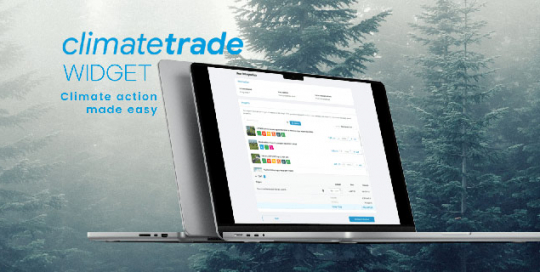
ClimateTrade Widget to facilitate carbon offsetting for SMEs
ClimateTrade News

ClimateTrade launches ClimateTrade Widget to facilitate carbon offsetting for SMEs

New tool makes it easier for companies of all sizes to offer transparent and traceable carbon offsetting service to their customers.  Valencia, November 16, 2021: ClimateTrade, the leading blockchain-enabled climate marketplace, announced today the launch of the ClimateTrade Widget, to allow companies of all sizes to offer transparent carbon compensation services to their customers almost instantaneously.  The Widget is quick and easy to integrate, which makes it particularly suitable to small and medium businesses or organisations with limited IT resources. With this new functionality, ClimateTrade extends its carbon offsetting services to the SME world, recognising that every business, no matter what size, has a part to play in achieving a net zero world. While large companies have been working toward decarbonisation for some time, many SMEs are lagging behind due to the complexity of carbon footprint calculations and offsetting. But today, the climate emergency is such that no one can afford inaction. Working toward carbon neutrality now can increase SMEs’ competitiveness in a market driven by conscious consumers. The ClimateTrade Widget removes the complexity of carbon offsetting. It can be easily customised and integrated into any commercial transaction platform to give customers visibility on the carbon footprint of the product or service they are purchasing, and offer them the option to offset emissions at check-out.  When integrating the widget into their platform, businesses can choose which ClimateTrade Marketplace carbon mitigation projects they want to present to their customers. Then, companies can either pre-purchase carbon credits from these projects to sell to their customers at the time of payment, or simply offer a direct purchase option to the end buyer. In both cases, buyers receive a nominative certificate with information about the exact project they have supported: full traceability is ensured by the blockchain infrastructure that powers the ClimateTrade Marketplace. The announcement follows the launch of the ClimateTrade API earlier this year, the world’s first Application Programming Interface for carbon offsetting. Both the API and the Widget serve the purpose of allowing companies on the ClimateTrade Marketplace to extend its services to their customers without ever having to leave their own webpage.  About ClimateTrade ClimateTrade is the world’s leading climate marketplace. The company’s environmental services help companies offset CO2 emissions and financing projects in order to achieve their sustainability goals with complete transparency and traceability. A pioneer in establishing a voluntary marketplace for climate credits, and having led the development of blockchain, ClimateTrade has launched a digital solution that allows and promotes the acquisition of carbon-neutral products and services by customers and suppliers of different companies. Contact us to request a demo of the ClimateTrade Marketplace, API or Widget.

Other Categories

Colombia registries onto its global climate platform
Carbon Markets

ClimateTrade adds Spain and Colombia registries onto its global climate platform in COP26 announcement

Valencia, Spain and Glasgow, Scotland – (November 8, 2021) – Alongside the UN COP26 meeting in Glasgow, Scotland, ClimateTrade, a pioneer in climate markets since 2017, today announced that it has incorporated the digital carbon registries of Spain and Colombia onto its climate marketplace. This marks the first time that a carbon trading platform has connected directly with national registries, allowing real-time offset cancellations and transfers, stimulating local projects and real-time outcomes generation.  The news was delivered today by CEO Francisco Benedito, during a panel discussion at the COP26 Sustainable Innovation Forum entitled: “Natural Capital: How We Make Nature Bankable.”  “ClimateTrade aims to offer governments and project developers a more efficient, less costly way to generate revenue for their capital nature, while allowing project developers and offset purchasers in these nations access to a secure, traceable, and verified climate registry, simplifying carbon credit accounting while maximizing value and impact,” said Francisco Benedito, CEO of ClimateTrade.  “By extending our platform into Spain and Colombia, we can offer those nations greater fairness in carbon pricing, bring more of their projects to market, and fulfill demand for verified credits from companies racing to zero their emissions,” he continued. “Thanks to our digital registry, and interconnected digital measurement, reporting and verification, we can allow project developers to generate their credits in real time, reduce the price for their generation and add more innovative digital methodologies to connect developers and purchasers.”  Establishing and connecting climate registries is a critical step in addressing the carbon market challenges posed in the Paris Climate Accords, and aids in bringing public and private markets into alignment with such international agreements. The ClimateTrade platform currently works with Ecoregistry and Iberclear (BME & SIX Group), but invites collaboration from others as well. “Our partners have seen the importance of a unified, transparent and collaborative system like ClimateTrade, and we invite other registries to join us as well in creating a more holistic, interdependent and collaborative platform for climate action,” Benedito said.  ClimateTrade’s ecosystem allows companies to easily offset their climate footprint by investing in verified environmental projects through disruptive blockchain technology. The company hosts a diversity of projects on its platform, from renewable energy, waste, reforestation, REDD+, NbS, soil, removals, blue carbon, and recently biodiversity and resilience – all aligned with the United Nations Sustainable Development Goals and helping to push forward its 2030 sustainability agenda. ClimateTrade’s proprietary API adds further value to its network, allowing companies to provide micro-offsetting in any commercial transaction. By means of a simple connection with the API, ClimateTrade partners can offer their customers the option to purchase offsets, and receive an official personalized certificate, while purchasing products and services. ClimateTrade is already a leader in the voluntary carbon market, serving corporations like Santander bank, Melià Hotels Int., Cabify, Telefónica, Prosegur, Suez, Sacyr and many others. ClimateTrade’s marketplace functions as a showcase for climate change mitigation projects, connecting project developers to companies with offsetting needs. Unlike conventional carbon markets, historically managed by brokers or commodity traders, ClimateTrade’s marketplace automatically records transactions and cancels credits in the corresponding registry, providing transparency, traceability and speed while eliminating the possibility of double accounting and greenwashing impediments. ClimateTrade’s blockchain technology reduces the costs involved in verifying transactions, by removing the need for trusted third-parties. ClimateTrade also recently partnered with Algorand, a leading blockchain technology company, pledging to be the greenest, fully carbon neutral blockchain as a result of their alliance.  About ClimateTrade ClimateTrade is the world’s leading climate marketplace. The company’s environmental services help companies offset CO2 emissions and financing projects in order to achieve their sustainability goals with complete transparency and traceability. A pioneer in establishing a voluntary marketplace for climate credits, and having led the development of blockchain, ClimateTrade has launched a digital solution that allows and promotes the acquisition of carbon-neutral products and services by customers and suppliers of different companies. Contact us to find out more.

carbon footprint measurement
Carbon Markets

The evolution of carbon footprint measurement

The practice of calculating carbon footprint is not old, yet it has already changed and adapted to new demands and technologies. Discover the history of carbon footprint measurement in this article. Humans have always known that their activities had an impact on the Earth and its resources, but it wasn’t until the 1990s that the concept of a ‘footprint’ first emerged. At the time, researchers started talking of our ‘ecological footprint’, which represented our use of resources compared to the Earth’s ability to renew them. Today, this concept is well understood thanks to Earth Overshoot Day, the day when all the resources the planet can produce in a year run out and we begin to live on future resources. This year, Earth Overshoot Day fell on July 28, a few days earlier than in 2021 and almost a whole month earlier than in 2005. The birth of the carbon footprint The concept of carbon footprint was born as part of the ecological footprint, as one indicator of our impact on the Earth. But the idea gained popularity in 2003 when oil and gas company BP launched an advertising campaign asking people on the street what their carbon footprint was. The ad encouraged people to calculate their personal carbon footprint – using BP’s calculator – to find ways to reduce it, with the slogan “It’s a start”. Because of that, the focus of the carbon footprint remained largely on individuals, despite companies (and especially oil and gas companies like GP) emitting much more problematic levels of emissions. In 2015, with the signing of the Paris Agreement, governments were able to analyze precise data about their countries’ carbon footprint, and the focus shifted to companies. Nowadays, much of the public and regulatory scrutiny regarding the carbon footprint is on corporations, with activists regularly denouncing the hypocrisy of campaigns such as BP’s. The discovery of global warming Scientists discovered that levels of carbon dioxide in the atmosphere could change the Earth’s climate in the 1800s, when investigating what had caused the Ice Age – that’s when the term ‘greenhouse effect’ was born. At the dawn of the 20th century, Swedish scientists Arvid Högbom and Svante Arrhenius were the first to estimate the amount of CO2 emitted from the burning of coal, and to warn about the warming effect of an increase in emissions.  But their theories were viewed with much skepticism until the 1950s, as World War II and the Cold War created a need for high military technology, leading to an increase in government funding for science. The scientific community discovered that the mechanisms thought to prevent global warming (such as the ocean’s absorbing effect) were not effective enough, and that emissions had already increased much more rapidly than previously thought. Still, their warnings were ignored as industrialization picked up pace. It’s only in the 1990s that people started to pay more attention to what scientists were saying about the climate, and to ask their governments for action. Severn Cullis-Suzuki’s passionate speech about climate change at the Rio Summit 1992 is a clear example of this shift. Corporate carbon footprint measurement As climate change became a more and more central concern in international conferences, certain pioneer companies began calculating and disclosing the environmental impact associated with their activities or products. Patagonia was one of the first to conduct a survey of its environmental footprint in 1991, and now the company plans to be carbon-neutral by 2025 – much earlier than most others. Since the 2010s, the number of companies calculating and disclosing their carbon footprint has increased dramatically and today, it has become a requirement imposed by regulators or investors in most countries. The way companies calculate carbon footprint is quite simple: they multiply each of their activities with the ‘emission factor’ of that activity. But the precision of this calculation has evolved greatly in recent years, as more data becomes available.  In 2001, the Greenhouse Gas Protocol was published, after a decade of development. It established standards and rules for the calculation of carbon emissions according to their scopes: direct emissions (scope 1), emissions from energy use (scope 2) and indirect emissions (scope 3). To this day, the GHG Protocol remains the tool most used by companies to calculate their carbon footprint. Carbon footprint calculators Despite being based on a simple formula, carbon footprint calculation is a complex exercise, particularly for companies. That’s why in general, they hire environmental experts or consultants to assess GHG emissions across their operations. But as data and our ability to process it improves, this exercise is becoming easier to automate. For instance, ClimateTrade offers sector-specific carbon footprint calculators for mobility, airlines and buildings, having digitized the data points included in the GHG Protocol. This means that companies simply have to enter data into the calculator to find out what their carbon footprint is. In the coming years, we expect automated calculators to grow more precise and more specialized in different sectors, becoming the preferred option for companies. However they conduct their carbon footprint calculations, companies then need to have the result audited to ensure accuracy, before they can report it to regulators and take measures to reduce and offset their impact.