
ClimateTrade News
Reibus International chooses ClimateTrade to achieve Carbon Neutrality.
The leading marketplace for metals reaches for carbon neutrality and pioneers sustainability to set a new industry standard.

The leading marketplace for metals reaches for carbon neutrality and pioneers sustainability to set a new industry standard.

Groundbreaking corporate forests initiative, giving companies a unique opportunity to grow their own forest.
As the world’s leading provider of blockchain-based climate technology solutions, ClimateTrade is thrilled to announce the appointment of Matt Puccini as Strategic Advisor.

ClimateTrade, the world’s first blockchain-based climate solutions provider, today announced the hirings of Alec Saltikoff and Michael Cassis as U.S. advisor and vice president of sales North America, respectively. These top-level hires demonstrate ClimateTrade’s commitment to expanding its reach in the U.S. and across North America.
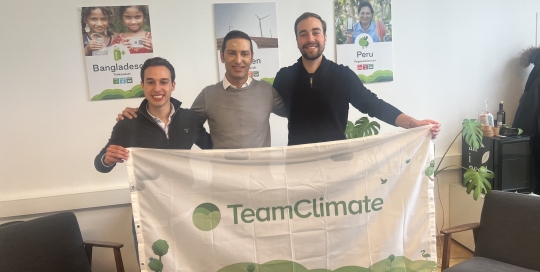
ClimateTrade, the world’s first blockchain-based climate solutions provider, has acquired climate neutrality company TeamClimate to expand its global reach and improve its product portfolio.

March is the month of SDG 6 – clean water and sanitation. Access to safe water is crucial for human health, but do you know how this issue relates to climate change?

30 November 2021, London – PlanetWatch, the world’s first decentralised indoor and outdoor air quality monitoring network, will now offer its user community the possibility to convert PLANET tokens into carbon credits issued by ClimateTrade to contribute to sustainable carbon emission reducing plans. Founded in 2020, PlanetWatch is a spinoff of the European Organization for Nuclear Research (CERN). The data collected by PlanetWatch air sensors is transcribed onto the Algorand blockchain, which makes this air quality repository immutable. There are currently 20,000 air sensors spread across the globe, with the number of PlanetWatchers rapidly increasing. The network went live on Algorand MainNet in August 2020. PLANET tokens are the firm’s utility tokens, earned when a sensor sends valid air quality data – and they can now be used to offset carbon emissions. “PlanetWatch and its community play such an important role in monitoring air quality around the world. It is a pleasure for ClimateTrade to be able to empower them to take even more direct climate action through carbon offsetting”, said Francisco Benedito, CEO and Co-Founder of ClimateTrade. Claudio Parrinello, CEO of Planetwatch, added: “We are delighted to announce our partnership with ClimateTrade, and are looking forward to a mutually beneficial relationship that will enhance the impact of both companies in their efforts to create a more sustainable environment”. “It is great to foresee that a fraction of our PLANET tokens will be used to support climate mitigation projects, while helping ordinary people make their own cities smarter and cleaner, for the benefit of us all”. ClimateTrade helps companies achieve carbon neutrality by allowing them to invest capital in proven and reviewed climate projects that fit the needs of the company. The firm developed the first carbon credit platform with blockchain technology, which allows responsible companies to offset their emissions by purchasing peer-to-peer carbon credits directly from mitigation project developers, avoiding intermediaries. About PlanetWatch s.a.s. Planetwatch s.a.s., is a high-tech startup based in France, less than a mile away from CERN. By leveraging synergically the Algorand blockchain, advanced data acquisition software developed at CERN and high-performance yet affordable air quality sensors, including advanced devices developed by a major research institute, Planetwatch decentralizes, incentivizes and gamifies environmental monitoring. Planetwatch is currently deploying dense, low-cost air quality monitoring networks delivering real-time data and building the first global immutable ledger for historical air quality data. For more information, visit https://www.planetwatch.io. About ClimateTrade ClimateTrade is a Spanish-based climate marketplace helping global brands achieve their sustainability goals by offsetting CO2 emissions and financing climate regenerative projects. Pioneering the development of its blockchain marketplace, ClimateTrade recently launched an API and a Widget that allow companies to offer carbon-neutral products and services to their customers. For more information: https://www.climatetrade.com/.

Several Spanish regions have created corporate carbon footprint registries to encourage emissions offsetting and contribution to local sustainability projects. Catalonia was the first in 2015 to encourage companies to report their emissions voluntarily. Andalucia followed in 2020 by setting up a voluntary registry with several new features, among which a connection to the State Ministry’s registry and the promotion of offsetting via marine projects (known as Blue Carbon). After that, the Balearic Islands made carbon footprint declaration and periodic verification mandatory for companies of more than 50 employees in 2022. Finally, the Canary Islands are now replicating Andalucia’s model with a voluntary registry for entities that choose to declare their carbon footprint. Catalonia: Voluntary corporate reporting since 2015 The voluntary agreement program for the reduction of greenhouse gas emissions (GEI) is a tool promoted by the Catalan Climate Change Office (OCCC) for those looking to make a voluntary GHG reduction commitment that goes further than what is required by law. Through the agreement, signatory organizations commit to follow their GHG emissions and establish reduction measures annually. Since 2015, these organizations have communicated their GHG emissions data to the OCCC annually, as well as their reduction measures. With this data, the OCCC creates a yearly analysis and presents it as a report with infographics with information about the type of organizations reporting, how many and what kind of measures they have put in place, as well as the global yearly variation in emissions. Andalucia: The first system connected to the Ministry The Andalucian System for Emissions Offsetting (SACE), is a voluntary set of measures created in 2020 to fight climate change and promote the transition to a new energetic model in Andalucia. It provides the corporate sector with the opportunity and the means to actively participate in the fight against climate change. Emissions reduction goals can be achieved partially or entirely through emissions offsetting, which in this system is represented by absorption units (UDA) generated by offsetting projects or self-offsetting of emissions. As a reflection of their profound collaboration, the Agriculture, Ranching, Fishing and Sustainable Development Council and the Ministry for the Ecological Transition and Demographic Challenge have created a simplified system for declaring carbon footprint on both SACE and on the Ministry’s carbon footprint, offsetting and capture project registry. This way, organizations that choose to declare their footprint in both registries can request to do so through SACE. SACE includes: Emissions report: self-assessment of emissions via a calculation tool provided by SACE Reduction plan: definition of a series of actions to reduce emissions Plan execution: achievement of the actions defined in the plan Offsetting: emissions that cannot be reduced can be offset through offsetting projects or self-offsetting Carbon absorption projects can include forestation, reforestation, restoration or conservation of existing forest areas, coastal ecosystems, meadows and Mediterranean forests, wetlands, marine vegetation or phanerogams and any other natural space, as well as projects aiming to protect or increase soil organic matter through agroforestry or agriculture. The difference between offsetting and self-offsetting depends on whether projects are located on public land (for offsetting) or on private land with authorization (for self-offsetting). Blue carbon innovation in Andalucia since 2021 The Andalucian Climate Change Office (OACC) also allows blue carbon absorption projects. In the framework of the Life Blue Natura project, coordinated by the Agriculture, Ranching, Fishing and Sustainable Development Council, carbon deposits held in fields of Posidonia oceanica and in tidal marshes have been quantified. These coastal ecosystems have been capturing carbon from the atmosphere for millennia – this is what we call blue carbon. Andalucia features vast tidal marshes and marina phenogram prairies. Financing for restoration and conservation projects in these habitats is made possible by turning them into absorption projects for offsetting organizations’ greenhouse gas emissions. The region has developed fundamental tools such, as the Andalucian carbon standard for the certification of blue carbon credits, the carbon sequestration calculator and the Andalucian catalog of blue carbon projects where the first such pilot projects have been listed: one in the Bahia de Cadiz Natural Park, and another in the Cabo de Gata Natural Park. Balearic Islands makes carbon footprint registration mandatory in 2022 After a legislative phase in 2021, the region is currently building the registry. The Balearic Island government is set to make it mandatory for medium and large companies to register their carbon footprint, after calculating emissions and having them verified independently by September 30th, 2022. Bill 48/2021, which came into force at the start of 2022, creates the Balearic carbon footprint registry and establishes the obligation for companies with 50 employees or more working from the islands, as well as those with an annual turnover of over €10 million, to register with the autonomous community government Annual carbon footprint calculations and emissions reduction plans must be added to the registry to comply with the Balearic climate change mitigation targets. The system also allows companies to mention their chosen CO2 sequestration projects, but this isn’t mandatory. The rest of companies, as well as individual citizens, can also register voluntarily to provide the government with the most precise information about the islands’ emissions, allowing it to set up the mechanisms necessary for their reduction. The structure of the information stored in the Balearic registry will be compatible with the one in the State registry. Canary Islands’ carbon footprint registry This will be a basic instrument to move towards decarbonization in the Canary Islands’ economy. All natural persons and legal entities can choose to register, though some will be obligated to do so by law. The information to register includes the annual calculation of the carbon footprint associated with activities in the Canary Islands, as well as data relating to emissions reduction plans and CO2 sequestration projects. Registry digitization: the next step The digital voluntary registry developed by Spain’s stock market operator BME and ClimateTrade, which was launched last February, will be key to the correct functioning of future voluntary carbon mechanisms, such as those mentioned above. On top of managing information

Although challenges remain, the new EU Nature Restoration Law champions biodiversity, climate goals, and offers exciting opportunities through instruments such as voluntary biodiversity credit markets.